Showing posts with label Thermodynamics. Show all posts

Saturday, November 25, 2017

Two Reversible Adiabatic Paths Cannot Intersect Each Other

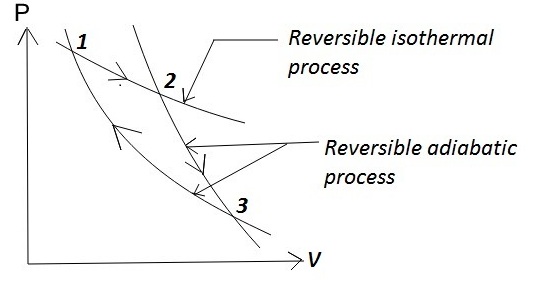
# Let us consider two reversible adiabatic paths 1-3 and 2-3 intersect each other at point 3. 


# Also a reversible constant temperature processes 1-2 be drawn in such a way that it intersects the reversible adiabatic paths at 1 and 2.

# These three reversible processes 1-2, 2-3, 3-1 constitutes a reversible cycle.

# We know that the area under the p-v plot represents the net work output in a cycle. Therefore the area under the three reversible paths represents the net work output in a cycle.

# But such a cycle is not possible, since net work is being produced ia a cycle by a heat engine by exchanging heat with a single reservoir in the processes 1-2, violates the Law of Thermodynamics (Kelvin-Plank). Therefore the consideration of the intersection of the two reversible adiabatic process is wrong.

# Through one point, only one reversible adiabatic can pass.

# As two constant property lines can never intersect each other, it is observed that a reversible adiabatic path must denote some property, which is found later that it is entropy.

Saturday, November 18, 2017

COMBINED FIRST AND SECOND LAW OF THERMODYNAMICS

Combined 1st and 2nd Law of Thermodynamics.


By first law of thermodynamics, ΔQ = dU + ΔW

Since ΔW = pdV

ΔQ = dU + pdV ----------------- 1.

From second law of thermodynamics, (Entropy concept)

ΔQ = T. dS ----------------------- 2.

Put equation 2. in 1.

We get, TdS = dU + pdv ---------------- 3.

We know that, enthalpy h = u + pv

On differentiating, we get

dh = du + pdv + vdp,

From equation 3. , dh = Tds + vdp

Tds = dh - vdp -------------- 4.


The equations 3. and 4. are the thermodynamic equations relating the properties of system.


The following are the relations obtained from the first and second laws.

1. dQ = dE + dW: Holds good for all process, reversible or irreversible and for all systems.

2. dQ = dU + dW: Holds good for any process undergone by a closed system.

3. dQ = dU + pdV: It is good for a closed system , where pdV work is present. This relation true only for quasi-static* process.

4. dQ = TdS: This equation is true only for a reversible processes.

5. TdS = dH –Vdp: This relation hold good for any process, since there is no path function term in the equation. 

6. TdS = dU + pdV: It is good for any reversible or irreversible process, undergone by a closed system. Since the properties in the relation which are independent of the path. 


Note:

* A quasi-static process is a thermodynamic process that happens very slowly  for the system to be in equilibrium. It is reversible.

Wednesday, November 15, 2017

Slope of constant volume and constant pressure processes in T-s plot

# For constant pressure processes(p=C),

ds = m . Cp . dT/T ---------------------- 1.


T-s Plot


# The slope of the curve in T-s plot is dT/dS

Therefore from equation 1.,  dT/dS = T/(m . Cp) ---------------- 2.


For 1 kg of perfect gas,  

Equation 2. becomes

dT/dS = T/Cp    {Since m = 1 kg} -------------------- 3.


# Similarly for constant volume processes(v=C),  

dT/dS = T/Cv --------------------- 4.


# For perfect gas, we know that

Cp > Cv 

or

1/Cp < 1/Cv  --------------------- 5.


# Compare equation 5. with equation 2. & 4.

T/Cp  <  T/Cv

or

{dT/dS} of v=C > {dT/dS} of p=C ----------------6.

Here {dT/dS} is slope of the curve in T-s plot.


# Therefore the slope of the curve for constant volume process (a-b) is higher than that of constant pressure processes (a-b’). 


Note ;

Constant volume process , v=C.

Constant pressure process , p=C.

Cp, Cv - Specific heats at constant pressure and constant volume.

ds - Change in entropy.


Sunday, November 12, 2017

Unit of Refrigeration


Tonne of Refrigeration (TR) 

The amount of heat removed (i.e., refrigeration effect) from 1 tonne* of water from 0 °C to make 1 tonne of ice at 0 °C in 24 hours.

It can also be explained as the amount of heat extracted to make 1 tonne of ice from and at 0 °C in 24 hrs.

To make ice from water at 0 °C, it is important to remove latent heat**.

For water, latent heat = 335 kJ/kg.

    Therefore, one tonne of refrigeration = 1000 X 335 kJ in 24 hrs.

   =  (1000 X 335 )/24 kJ/hr
     
   = 13,958.3 kJ/hr

   =  (1000 X 335 )/(24 X 60) kJ/min

   = 232.6 kJ/min

In practice, 1 tonne of refrigeration is equivalent to 210 kJ/min or 3.5 kJ/Sec of heat.


Note:

*1 tonne is equivalent to weight of 1000 kg.

**Amount of heat transfer required to cause a change of phase in mass of a substance at constant temperature and pressure.